
Parenthood
7 January 2026
Video feedback strengthens practice in daycare
Research
Seeing yourself on video work. A new study shows that video feedback can strengthen the interaction between pedagogical staff and children in Copenhagen nurseries.
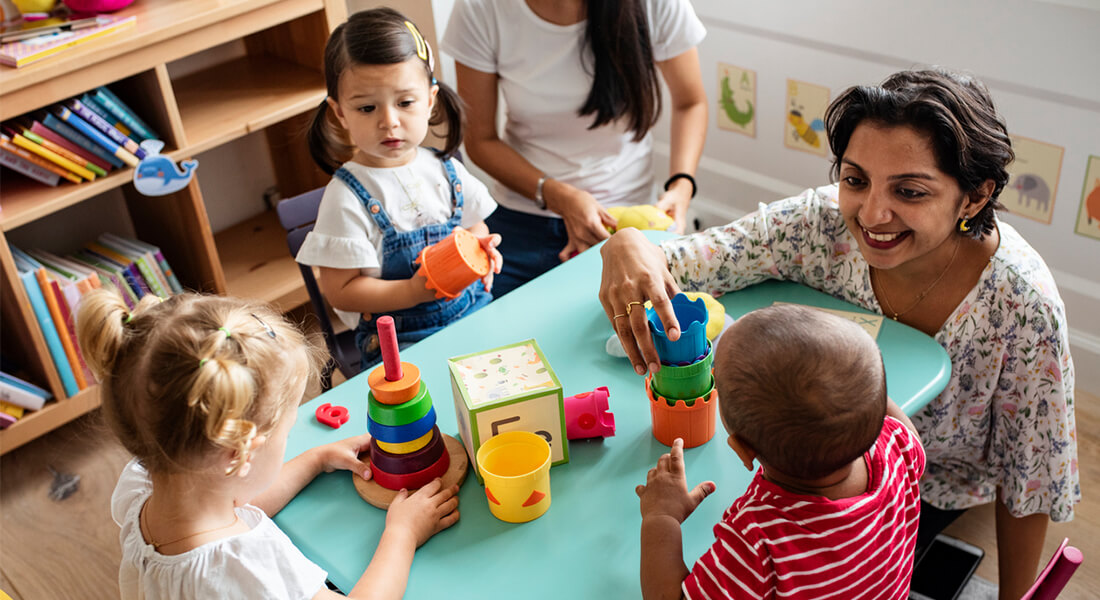
In a joint project, the Centre of Excellence in Early Intervention and Family Studies (CIF), the Municipality of Copenhagen and University College Copenhagen (KP) tested a professional development programme focused on enhancing the quality of interactions between pedagogical staff and children in Copenhagen nurseries. More than 200 staff members took part in the video‑based feedback programme, and the project The Copenhagen Daycare Project now reports promising results.
Daycare is a key developmental arena for young children. Many join a peer community for the first time, play on the playground and learn to wait their turn at morning assembly. But simply attending nursery is not what drives children’s development.
Encounters with pedagogical staff play a crucial role – it is through daily interactions with adults that children develop, are supported in their desire to play, explore and engage in relationships with peers. The quality of the interactions that children experience throughout the day is therefore critical to whether they benefit from the developmental opportunities that the daycare provides.
This was the main motivation for the research project, explains Mette Skovgaard Væver, Professor and Director of CIF:
– We know that interaction quality is the most important quality parameter in daycare for supporting children’s development – especially for children in vulnerable positions. There is every reason to focus on interaction quality and on how we can strengthen it in daycare settings.
In 2022, the project group – in collaboration with the Municipality of Copenhagen and University College Copenhagen – began testing the Dutch‑developed professional development programme Caregiver Interaction Profile (CIP) in a Danish nursery context. CIP is a practice‑oriented, video feedback‑based programme designed to promote six core interaction competencies among pedagogical staff.
Communities contribute to the development of children’s emotion regulation
One of the major developmental tasks in the first years of life is learning to regulate emotions – and children learn this through interactions with both adults and other children in nursery, says Ida Egmose Pedersen, Tenure Track Assistant Professor and Head of the research programme The Child in Daycare:
– Suddenly someone does not want to play what you want, or you want to play with a toy someone else is using. These are good – and important – opportunities to participate in communities and practise regulating emotions in relationships. For children to learn this, they naturally need support from adults.
Research shows that effective strategies for regulating – especially – difficult emotions, such as sadness, fear or frustration, are crucial to children’s further development.
Seeing yourself on video works
Initial analyses of staff competencies before and after the CIP programme show that participation strengthened staff competencies in several areas. After completing CIP, pedagogical staff provide more emotional support to children and stimulate their development better.
The CIP programme also appears to strengthen staff efforts to promote positive peer interactions. According to Ida Egmose, this is a result worth highlighting:
– Participating in communities and having good peer relationships are immensely important for children’s development. Children’s early learning in nursery about how to join play and resolve conflicts is vital for their well-being and development, both in the present and in the long term.
The effects of the CIP programmes were examined using a randomised controlled study, which provides a solid basis for assessing whether improvements in participants’ interaction competencies can in fact be attributed to CIP.
What is next?
The next step for the research team is to identify a model for how CIP can be scaled in daycare settings and municipalities now that the research project has concluded.
They are exploring whether an e‑learning programme focused on CIP’s interaction competencies can produce some of the same positive results as the full CIP programme. In addition, a newly launched PhD project will focus on adapting CIP to include kindergartens and on how CIP might be integrated into collaboration between pedagogical staff and the educational psychology advice unit (PPR) in municipalities.
On 23 January 2026, CIF will host a concluding research conference at the University of Copenhagen, where you can learn more about CIP, the study’s results and gain inspiration for implementing practice‑oriented professional development in Danish daycare settings.
Register for the conference. Participation is free.